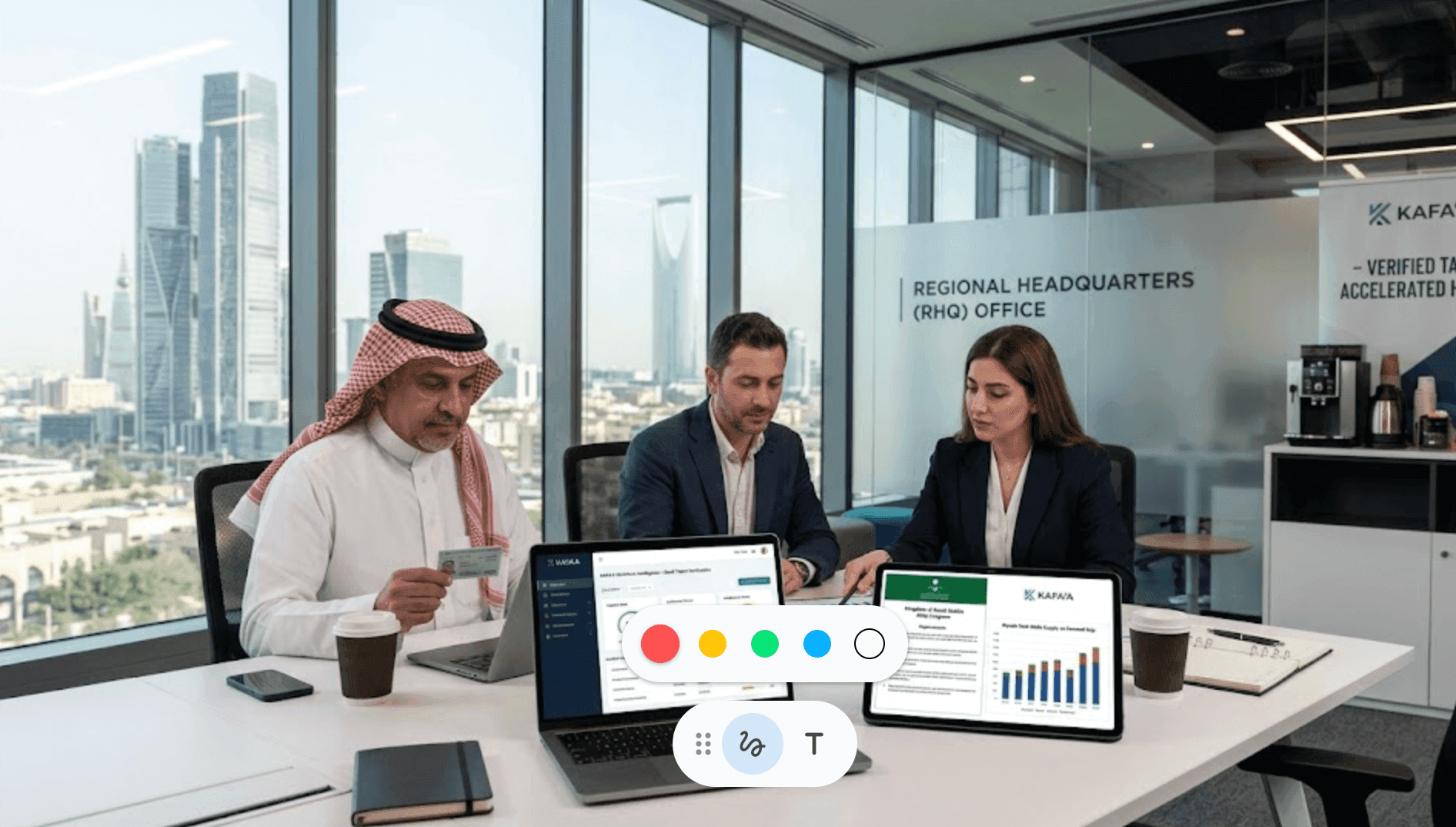
Saudi Arabia is rapidly becoming a regional hub for global enterprises as more companies establish offices under the RHQ program Saudi Arabia introduced in 2024. But while business opportunities are expanding, many MNCs are struggling to find qualified talent in Riyadh.
The growing demand for skilled professionals, combined with local compliance and hiring challenges, is creating pressure on enterprise recruitment. This blog explores the Riyadh talent challenge, why traditional hiring models are failing, and how workforce intelligence platforms like KAFA'A are helping companies hire smarter.
Understanding Saudi Arabia's RHQ Program
Saudi Arabia made a big change in 2024. From January 1, 2024, any global company that wants to work with the Saudi government must set up its regional office inside the Kingdom. This rule is part of the RHQ program Saudi Arabia launched under Vision 2030, the country's plan to build a stronger, oil-free economy. Companies that do not follow this rule cannot bid on government projects. This includes mega-projects like NEOM, Red Sea Global, and Diriyah Gate.
The RHQ program Saudi Arabia comes with strong benefits for companies that qualify:
Zero corporate tax and zero withholding tax for 30 years
No Saudization requirements for 10 years
Unlimited employee visas
Free premium residency for top three executives
But these benefits come with clear rules too. An RHQ must hire at least 15 full-time employees including at least 3 senior executives within the first year. The office must also have real decision-making power over at least two other countries in the MENA region.
For most big companies, following these rules is manageable. The real problem is something else: finding the right people to actually fill those roles.
Why Global Companies Are Moving to Riyadh
Saudi Arabia aims to attract hundreds of multinational regional headquarters by 2030. And the numbers are moving in that direction. Riyadh is fast becoming one of the top business cities in the Gulf. It offers great infrastructure, a growing finance sector, and direct access to government-backed projects worth hundreds of billions of dollars.
For any global company with big Middle East plans, the Riyadh regional headquarters program is no longer a choice; it is a requirement. Missing it means missing government contracts. So companies from tech, healthcare, energy, finance, and consulting are all rushing to set up in Riyadh at the same time.
This rush has created a problem nobody expected: too many companies chasing too few qualified people.
The Talent Challenge Facing MNCs in Riyadh
Here is something surprising. Saudi Arabia has reported record-low unemployment levels in recent years. Saudi nationals were at 6.3%, beating Vision 2030 goals six years early. That sounds great. But at the same time, many HR professionals in Saudi Arabia report increasing difficulty finding qualified talent.
How is that possible? Because the jobs being created require very specific skills and the shortage of experienced professionals is sharpest in those exact areas. A 2025 report found a 20% gap between tech job openings and qualified local candidates. Roles like AI engineers, cloud architects, and data analysts are in very short supply.
The problem is even bigger for senior roles. A 2023 PwC survey found that 58% of Saudi firms struggled to fill key tech positions. Senior Saudi professionals—especially those who are bilingual and experienced at the international level—are being pulled in many directions at once. Companies are offering salaries 60% higher than what people currently earn just to attract them. This has created what experts call "salary wars."
Why Traditional Hiring Models Are Failing
Most global companies hire the same way everywhere: post a job online, collect CVs, run interviews, and hire. But that model does not work well in Saudi Arabia. Here is why:
Job boards get flooded with hundreds of applications, making it hard to find the right person
Credentials and work history are hard to verify in a market with high expatriate movement
Fake or exaggerated profiles, sometimes called "ghost candidates," can put an RHQ license at risk
Global hiring methods do not account for local Saudi compliance rules
Beyond this, there is a deeper problem. Many MNCs try to copy their home-country hiring model in Riyadh. But Saudi talent localization requirements, local language needs, cultural expectations, and licensing rules make that a bad fit.
To qualify under the RHQ license, a hire must tick three boxes: the right skills, the right documents, and the right compliance profile. When even one of these is missing, companies face delays, extra costs, and sometimes threats to their RHQ status. The growing demand for skilled talent is not just a people problem. It is a data and process problem.
For companies looking beyond traditional recruitment channels, MENAJOBS provides AI-powered talent discovery focused on the Middle East’s fast-growing technology workforce.
The platform helps enterprises connect with pre-screened professionals across AI, engineering, and data roles while accelerating recruitment workflows.
How Workforce Intelligence Improves Talent Alignment
What MNCs really need is not more candidates. They need verified candidates. Workforce intelligence means checking a person's identity, qualifications, and work history against real government records before they even come in for an interview.
This is very different from reading a self-written CV. A workforce intelligence platform connects directly to national ID systems, civil records, and regulatory databases. Every candidate on the platform is already verified. For companies in the Saudi corporate expansion initiative, this means:
Verification that used to take weeks now takes seconds
Risk of hiring someone with fake credentials is removed from the start
Every hire is aligned with what the RHQ license actually requires
This turns the hiring process from a compliance risk into a real advantage. Companies can move faster, hire smarter, and stay on the right side of Saudi regulations, all at the same time.
How KAFA'A Supports the Future of Enterprise Hiring in Saudi Arabia
KAFA'A is an AI-powered workforce platform built for governments and employers across the GCC. It is designed to support national employment programs, verify candidate identities, and help companies meet Saudi workforce development goals at scale. For MNCs setting up under the Saudi RHQ initiative, KAFA'A makes sure every hire is backed by real, verified data from day one.
KAFA'A is designed to support enterprise hiring workflows through AI-powered talent matching, identity verification, and compliance-focused onboarding:
Biometric Onboarding — Candidates verify their identity using regional ID systems, creating a secure, government-linked digital profile
AI Matching — KAFA'A's AI engine matches verified talent to the right roles, based on skills, regulatory needs, and RHQ license requirements
Compliance-focused — Integrations help support regulatory workflows for seamless compliance reporting
Instant Placement — Verified candidates are placed into roles with a secure digital credential records that stands up to any audit
For companies dealing with both the Riyadh regional headquarters program requirements and the Riyadh talent shortage, KAFA'A removes the biggest risk from the hiring process: uncertainty. Every candidate that comes through is already checked, already compliant, and already matched.
KAFA'A also takes data security seriously. Its zero-trust security model is built on sovereign cloud infrastructure. All data stays within national borders. KAFA'A emphasizes enterprise-grade security and compliance practices and uses AES-256 encryption, the same level used in banking. This is what makes Saudi talent localization trustworthy, not just on paper but in practice.
Conclusion
The RHQ program Saudi Arabia has changed the rules for every global company that wants to do business in the Kingdom. Setting up in Riyadh is now the entry point, not a bonus move. But getting the license is only the beginning. The real work is building a team that meets Saudi talent localization standards: verified people, in the right roles, with the right compliance profile.
The Riyadh talent shortage is real and it will not fix itself. Old hiring methods were not built for this level of complexity. Workforce intelligence—the kind that KAFA'A delivers—is how smart MNCs are solving this problem today. For any enterprise serious about growing in Saudi Arabia, verified talent intelligence is no longer a nice-to-have. It is the foundation everything else is built on.